

The Backroom Still: Heavy Machinery, BOM Costs, and Real TurnKey Hardware
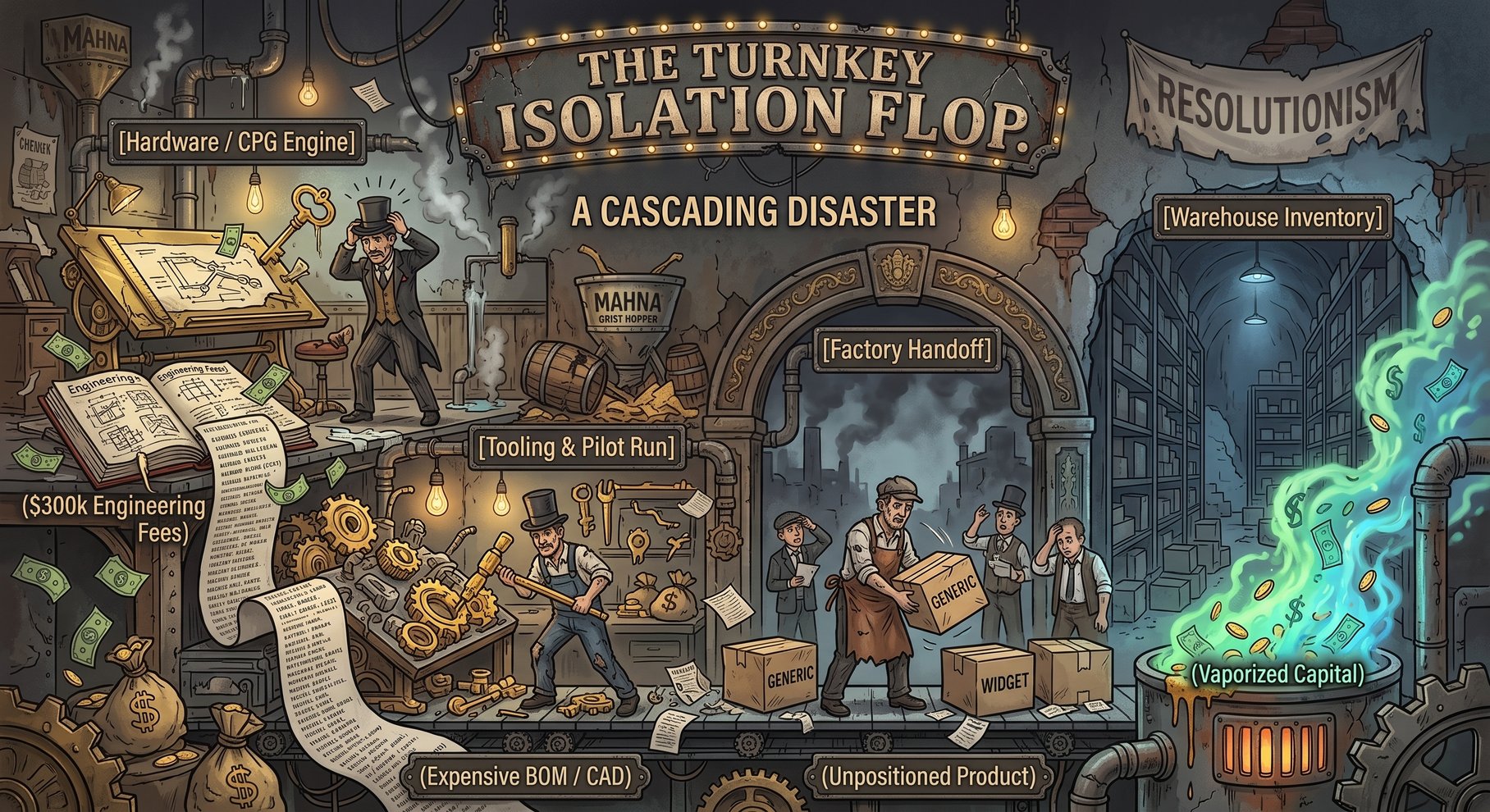
If you listen to the mechanical panjandrums running traditional TurnKey hardware and CPG commercialization engines, all it takes to conquer a market is a high-spec CAD drawing, a Design for Manufacturability (DFM) technical file, and a negotiated Bill of Materials (BOM) cost sheet. They will gladly bill you $300,000 in milestone engineering fees to build a polished physical prototype, validate custom tooling, and clear pilot batch runs in a co-packer's mixing tank.
Then comes Monday morning. You are handed a shipping container full of factory-ready SKUs, a heavy tooling invoice, and zero commercial velocity. These turnkey rackets operate in total isolation—building physical objects in a vacuum while completely ignoring brand soul, go-to-market channels, and unit-economic P&L math. You end up with a mechanical masterpiece or a shelf-stable formula that sits on warehouse pallets collecting dust because nobody stopped to ask if a real human being actually wanted the gadget.
|
Commercial Dimension |
TurnKey Hardware & CPG Commercializers |
MYNS2 Heliosphere Practice |
|
Primary Scope |
DFM engineering, physical prototyping, BOM costs, contract manufacturing sourcing |
Integrated category resolution, brand doctrine, CPG formulation, margin math, and floor execution |
|
Pricing Model |
Engineering milestone fees ($35k–$300k+), tooling retainers, unit-royalty structures |
Hard 90-day operating rhythm; resolved outcome or we halt |
|
Market Positioning |
Zero; assumes the client's product brief is commercially sound |
Mahna RPM Engine (Casing the Joint, Sizing Up, Testing the Lock) |
|
Brand Doctrine |
Absent; treats packaging and brand identity as downstream cosmetic decals |
Geppetto's Workshop (Carving a brand soul that walks off shelves on its own) |
|
Formulation Math |
Lab-scale chemistry that collapses or breaks margin when scaled to factory tanks |
Mrs. Beeton's Still-Room (Green-eyeshade bookkeeper precision co-packers can run) |
|
Execution Handoff |
High friction; hands off specs and leaves client to manage retail sales and P&L burn |
Zero handoff loss; Appleseed's Orchard embeds C-suite leadership directly on your floor |
Anatomy of a TurnKey Flop: Heavy Machinery in a Vacuum
TurnKey physical engines excel at mechanical tolerance, regulatory compliance, and supply chain logistics, but they operate with complete blind spots regarding consumer habits and channel physics. When a physical product is engineered without answering Question 5 (The Alternative-To), the result is an over-engineered, capital-draining flop.
Case Study 1: Keurig Kold – The $370 Pod Machine That Choked on Cost-in-a-Glass Math
Keurig spent over five years and hundreds of millions of dollars partnering with hardware engineering engines to build Keurig Kold—a countertop appliance designed to make cold, carbonated Coca-Cola beverages at home using proprietary pods. From a pure TurnKey hardware perspective, the device was an engineering marvel: custom thermal-chilling architecture, precise carbonation pod dosing, and certified manufacturing compliance.
The structural seam split wide open the moment the device hit the kitchen counter. The appliance retailed for a staggering $370, took up massive counter space, required 30 to 60 seconds to chill a single glass, and each pod cost $1.25 for an eight-ounce serving. The TurnKey hardware firm executed the mechanical brief flawlessly but completely ignored Tenet 3 (See Reality, Not Illusion) and Axiom 1 (Closure). They built a complex machine without asking Question 5 (The Alternative-To): What does the shopper reach for if this machine isn't on the counter? The shopper reaches for a 2-liter bottle of Coca-Cola from the local corner store for $1.50. Unable to justify the cost-in-a-glass math or the bloated BOM, Keurig discontinued the product just ten months after launch, writing off hundreds of millions in vaporized capital.
Case Study 2: Segway – The Over-Engineered Gyroscope
Segway was touted by hardware visionaries as the future of urban transportation. Backed by world-class mechanical engineering, rapid prototyping, and custom DFM tooling, the self-balancing electric vehicle was a technical triumph.
However, the hardware development occurred in a strategic vacuum. The engineering team failed to account for municipal sidewalk regulations, retail distribution friction, or consumer social embarrassment. Segway violated Tenet 2 (Align, Don't Dominate) and Axiom 3 (Identity) by attempting to force an expensive, bulky $5,000 machine into pedestrian environments where people were already perfectly content walking or riding bicycles. Lacking a load-bearing identity or a settled GTM route, Segway failed to hit its mass-market sales projections by over 99 percent.
How MYNS2 Fixes the TurnKey Flop
Step past the velvet curtain at MYNS2 and you will find zero hardware or CPG work done in isolation. We eliminate the catastrophic value leakage that occurs when engineering hands off to marketing by operating as an integrated Heliosphere:
- Before a single CAD drawing is rendered or a mixing tank is filled, our strategic team runs The Case through the Mahna RPM to map the live market tensions and isolate the exact middle position the category is hiding.
- If brand identity is required, Geppetto's Workshop carves a load-bearing brand doctrine into the physical object so it walks off retail shelves on its own two feet.
- If CPG or beverage formulation is required, Mrs. Beeton's Still-Room builds the recipe with green-eyeshade bookkeeper precision, proving cost-in-a-glass math and co-packer tank scalability before a single dollar is committed to packaging tooling.
- To ensure unit-economic P&L viability, Pennybags' Abacus and our self-serve software tool Ledgerdemain tune compounding marginalia levers directly inside your ledger.
- When it's time to run the factory floor, embedded C-suite leadership from Appleseed's Orchard takes a chair on your land to plant, tend, and execute the build without handoff loss.
Cracking the Hardware Vault: The Mahna RPM Strategy Engine
When a client arrives trapped inside a locked physical or CPG category—a Vault where every hardware prototype returns the same bloated BOM and every brief falls flat against industry inertia—we do not charge six figures for CAD adjustments. We deploy the Mahna RPM, our proprietary strategic engine that turns mechanical gridlock into executable motion.
Guided by Resolutionism: Real Value vs. Looting Cascades
Every engagement past our velvet curtain is governed by Resolutionism—our operating doctrine asserting that a business is a living rhythm across a value network, and any commercial plan relying on manufactured consumer panic, hidden tooling markups, or laundered supply-chain extraction is a looting cascade wearing corporate clothing.

To keep an enterprise on the Beam, every strategy and physical build forged inside our grist hopper must satisfy the four group axioms of a self-balancing ledger:
- Axiom 1: Closure (No Off-Book Transactions): Every operational cost—workforce health, vendor fairness, factory scrap rates, and co-packer commitments—must sit directly on the visible ledger. Pushing supply-chain extraction off-book to fake short-term unit margins breaches Closure.
- Axiom 2: Associativity (One Story Across All Vantages): The commercial ledger reads identically whether viewed by an investor, an auditor, a bench formulator, a retail buyer, or an end consumer. If a product story requires modifiers or fine print to balance from a specific angle, the product is broken.
- Axiom 3: Identity (The Sovereign Center & Alternative-To): Before setting directional motion or cutting steel tooling, an enterprise must answer Question 5 (The Alternative-To): What does the shopper reach for on the shelf if your product vanishes tomorrow? Naming the default posture or unmet habit gives the business a load-bearing identity.
- Axiom 4: Inverse (Every Extraction Met by Restoration): Every operational draw against the value network must be dischargeable and actively discharged. Unsustainable factory debt, supplier squeeze, or raw material exhaustion violates Inverse and triggers systemic decay.
When all four axioms hold, the enterprise generates Native Profit—the clean, mathematically verified surplus left over when every debt across the value network is fully discharged.
Step Past the Velvet Curtain: The MYNS2 Heliosphere
We do not run an assembly line where hardware engineering hands off to design, design hands off to formulation, and launch teams run around asking who's on first. MYNS2 operates as a Heliosphere: a bounded practice where integrated capabilities orbit a central strategic vortex, managed by one Impresario keeping the vision coherent alongside a curated bench of senior operators.

Every room in our sphere is built to eliminate handoff loss and drive native profit:
- Mahna RPM Strategy Engine: Diagnose structural rifts and chart your physical GTM flight plan.
- Geppetto's Workshop: Carve your brand's soul into an object that walks off retail shelves on its own two feet.
- Mrs. Beeton's Still-Room: Formulate unshakeable CPG recipes with green-eyeshade bookkeeper precision.
- Pennybags' Abacus & Ledgerdemain: Tune P&L marginalia to unlock Native Profit and test your numbers self-serve.
- Appleseed's Orchard: Deploy embedded fractional C-suite leadership (CMO, COO, CFO, Chief Innovation Officer) to run your factory floor.
- The Blind Pig Ledger: Read our public essays and case diagnostics.
Stop paying TurnKey hardware houses for expensive prototypes that choke on retail reality. Belly up to the bar at MYNS2—we will give you an unvarnished read on your business, tell you if you shouldn't hire us, and hand you an operational plan that steps into the market on its own two feet.
BLexi-Clog
A glossary of proprietary terms and speakeasy lexicon used throughout this post:
|
Word / Term |
Definition from MYNS2 Lexicon |
|
Appleseed's Orchard |
The execution arm of MYNS2 where embedded fractional C-suite operators take a seat on a client's land, run the floor for a defined tour, and hand over a functioning operation. |
|
Geppetto's Workshop |
The CPG brand invention room at MYNS2 where inert product ideas get carved, named, given a voice, and transformed into walking brand doctrines. |
|
Heliosphere |
The bounded working practice of MYNS2 where all capabilities (strategy, brand, formulation, execution, margin) orbit a central strategic engine without silos or handoff loss. |
|
Ledgerdemain |
Sleight of hand math for your P&L; MYNS2's software app that finds and tunes compounding marginal utility levers in a client's financial ledger. |
|
Looting Cascade |
An extractive corporate scheme where short-term numbers are inflated by taking value from workers, vendors, consumers, or supply chains out of sight on the ledger. |
|
Mahna RPM |
The overarching proprietary strategic hopper and methodology used by MYNS2 to turn raw market ideas into sequenced operational plans. |
|
Mrs. Beeton's Still-Room |
The CPG formulation laboratory at MYNS2 where food science, sensory panels, and bench-card scale-ups are executed with bookkeeper precision. |
|
Native Profit |
Clean, sustainable financial surplus generated when an enterprise satisfies all four group axioms across its entire value network without extracting from workers, suppliers, or consumers. |
|
Panjandrums |
Self-important corporate authorities who pretend to hold absolute wisdom without operational accountability. |
|
Pennybags' Abacus |
The money-work practice at MYNS2 where senior team operators directly analyze P&L ledgers using Marginal Utility Theory to surface hidden profit levers. |
|
Resolutionism |
The core doctrine and philosophical approach of MYNS2 asserting that every enterprise is a living rhythm across a value network, and structural paradoxes must be held and resolved rather than smoothed over. |
|
The Alternative-To |
Question 5 of the Resolutionism audit: the single-sentence definition of the exact default posture, habit, or product a consumer reaches for if your product vanishes tomorrow. |
|
The Haul |
The final resolved strategic asset delivered by MYNS2—a fully actionable, non-consensus category entry plan ready for immediate execution. |
|
The Syndicate |
MYNS2's collective practice of Safecrackers and strategists who run the Mahna RPM. |
|
The Vault |
A client's locked strategic exploration, market category, formula barrier, or competitive landscape. |
External Industry Review References
For factual verification and review of external industry failure examples referenced in this post:
- Keurig Kold Commercial Failure: "Keurig Discontinues Kold Drink Maker After 10 Months," The Wall Street Journal, June 2016; see also: "Why the $370 Keurig Kold Machine Failed," Harvard Business Review, 2017. (Documenting $370 hardware pricing, high pod cost-in-a-glass math, excessive counter footprint, and total product discontinuation).
- Segway Hardware Launch Flop: "Segway: The Mechanical Triumph That Failed to Move the World," Bloomberg Businessweek, 2015; "Why Segway Failed to Revolutionize Transportation," MIT Technology Review, 2020. (Documenting over-engineered gyroscopic hardware, municipal regulatory friction, lack of Question 5 positioning, and mass-market sales failure).
- Hardware & CPG Commercialization Benchmarks: "TurnKey Physical Product Development & DFM Sourcing Costs," e-Novia & Industrial Design Society Report, 2025/2026; "Supply Chain Execution Loss in Physical Product Launches," McKinsey Operations Review, 2025. (Confirming high tooling retainers, BOM cost friction, and execution drop-off during factory handoffs).