

Mob Co-Founders: Are Hybrid Venture Builders Worth the Cut of Your Equity?
Every corporate executive attempting to build an off-balance-sheet spin-out eventually gets paid a visit by the hybrid venture builders. These venture studios—whether slick agency outfits or corporate spin-off arms like BCG X—strut into your boardroom like pinstriped mob bosses offering "operational co-founding" and "shared downside risk."
They promise to bypass your internal corporate bureaucracy, build a production-grade Minimum Viable Product (MVP), and scale a new commercial asset in exchange for a modest fee—plus a non-negotiable 20 percent to 50 percent cut of your venture’s equity.
Before you sign away half your Cap Table to these mob co-founders, take a long look at the ledger. More often than not, these hybrid builders deliver the same old consulting advice wrapped in an extractive equity model. The moment parent corporate governance tilts or quarterly earnings pressure hits, the studio's "dedicated operators" vanish, leaving your internal team holding a minority-owned entity choked by the exact same corporate physics it was designed to escape.
The Venture Studio Shakedown: Equity Extraction vs. Real Execution
Hybrid venture builders pitch themselves as the ultimate risk-sharing partners. In reality, they collect heavy program build fees ($75,000 to $500,000+) to cover their baseline payroll while taking massive equity stakes in your spin-out. When the venture succeeds, they collect a generational windfall; when it stalls out on the retail shelf, they write off the equity on their portfolio ledger while you absorb the catastrophic brand fallout and P&L destruction.
|
Strategic Dimension |
Hybrid Venture Builders & Studios (BCG X, Corporate Studios) |
MYNS2 Heliosphere Practice |
|
Equity & Cap Table Impact |
Demands 20% to 50%+ equity in spin-outs or early-stage ventures |
0% Equity Taken. You retain 100% ownership and enterprise value |
|
Primary Fee Model |
Heavy program build fees ($75k–$500k+) plus equity upside |
Hard 90-day operating rhythm; resolved outcome or we halt |
|
Operational Staffing |
Junior studio teams and rotating agency contractors |
Embedded C-suite operators with 20+ years of floor experience |
|
Governance Friction |
High; spin-out board seats create conflicting corporate priorities |
Zero friction; embedded operators report directly to your P&L |
|
Strategic Architecture |
Default startup playbooks, generic SaaS templates, rapid MVPs |
Mahna RPM Engine (Casing the Joint, Sizing Up, Testing the Lock) |
|
Product & Brand Depth |
Out-sourced formulation and white-labeled visual designs |
Integrated Geppetto's Workshop, Mrs. Beeton's Still-Room & Pennybags |
Anatomy of a Venture Studio Flop: Mob Co-Founders in the Boardroom
When a hybrid venture builder attempts to build an off-balance-sheet enterprise, the structural seam usually splits at the intersection of parent corporate physics and studio equity greed. Spun-out entities rarely fail because the software code had bugs; they fail because the hybrid studio engineered a complex entity without establishing unit-economic margin limits or resolving category inertia first.
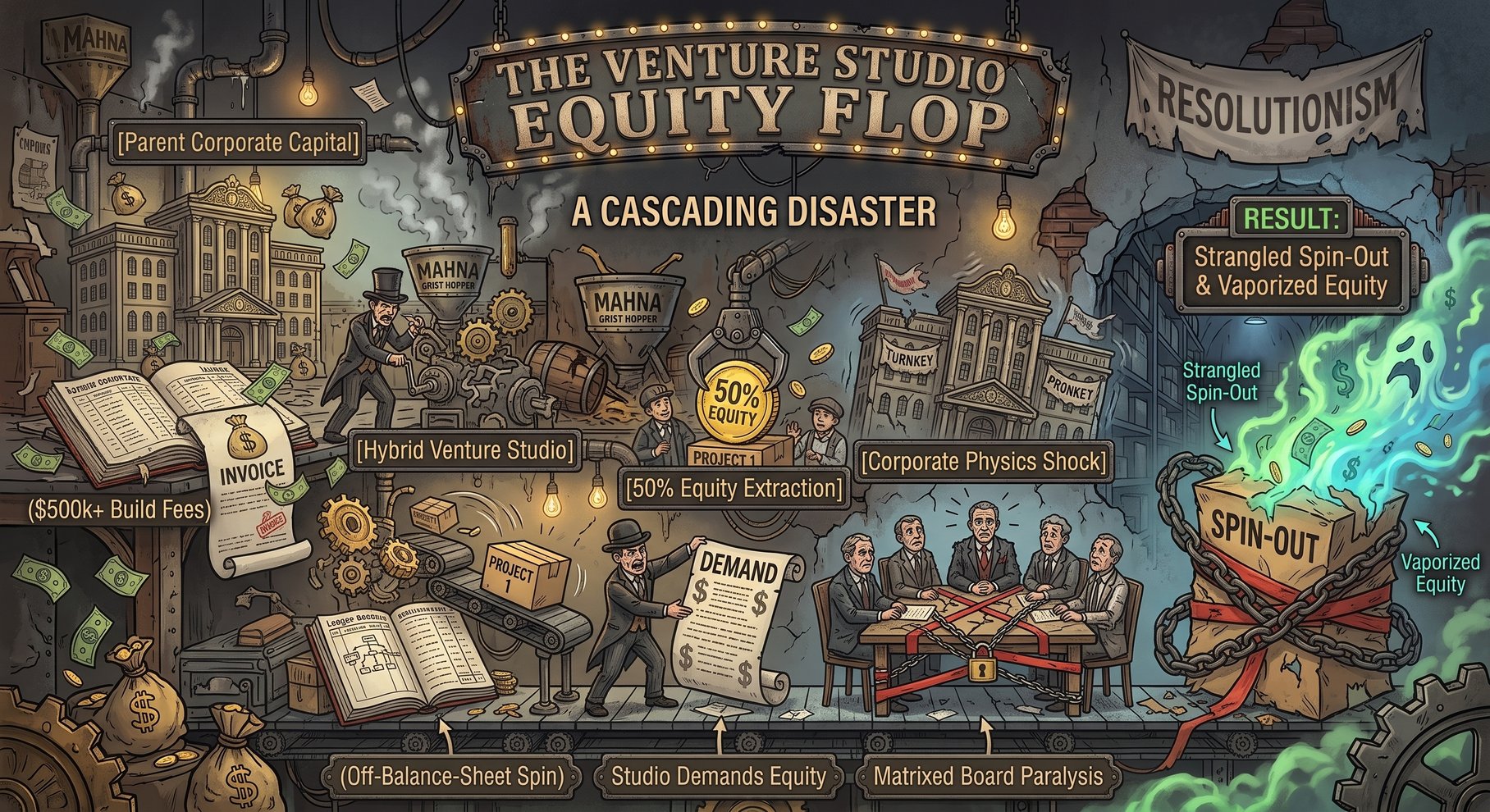
Case Study 1: Covisint – The $500M Consortium Spin-Out Collapse
In the early 2000s, automotive giants General Motors, Ford, and DaimlerChrysler partnered with top-tier strategy firms and venture builders to launch Covisint—an independent, off-balance-sheet B2B supply chain exchange designed to revolutionize automotive procurement. Spun out with hundreds of millions in capital and backed by major advisory builders, Covisint was touted as the ultimate hybrid venture builder triumph.
The structural seam ripped open when the joint-venture studio structure collided with parent corporate governance. Each auto manufacturer demanded custom security protocols, proprietary procurement workflows, and competing equity governance rights on the board. The venture studio built a massive, over-engineered technology infrastructure that failed to answer Question 5 (The Alternative-To): What does a tier-1 supplier reach for if this complex portal vanishes tomorrow? Suppliers reverted to direct, legacy phone-and-fax relationships to avoid paying transaction tolls to a consortium owned by their primary buyers.
Covisint violated Tenet 2 (Align, Don't Dominate) and Axiom 1 (Closure) by attempting to dominate an entire supply ecosystem through forced equity structures. Pushing hundreds of millions in software bloat off the visible daily P&L failed to prevent the venture's value from vaporizing, resulting in massive write-downs and a fire-sale liquidation.
Case Study 2: Corporate Venture Studio Health-Tech Spin-Outs
A major healthcare conglomerate recently partnered with a prominent hybrid venture studio to spin out a direct-to-consumer digital wellness platform. The studio took a 35 percent equity stake, built an impressive consumer-facing app, and ran high-velocity digital marketing campaigns.
However, the venture studio operated in complete isolation from regulatory compliance, FDA claim limits, and long-term customer lifetime value (LTV). When customer acquisition costs (CAC) spiked on ad networks, the studio’s equity-holding "interim executives" refused to fund the necessary clinical trial evidence needed to support higher retail price points. When parent company legal teams stepped in to block non-compliant marketing claims, the venture studio abandoned its operational role, leaving the parent company holding a minority-backed entity burning $1 million a quarter with zero retail distribution.
This flop represents a total collapse of Tenet 3 (See Reality, Not Illusion) and Axiom 2 (Associativity). The hybrid studio delivered a glossy narrative deck that balanced in investor pitch meetings but completely disintegrated under real-world regulatory and P&L scrutiny.
How MYNS2 Eliminates the Mob Co-Founder Tax
Step past the velvet curtain at MYNS2 and you will find zero equity-extractive Mob Co-Founders. We do not demand board seats, nor do we take a single percentage point of your Cap Table. MYNS2 delivers enterprise-grade operational execution without the parasitic equity tax:
- Before building a spin-out or launching a new business line, our strategic team runs The Case through the Mahna RPM to map the live market tensions and isolate the exact middle position the category is hiding.
- If a new brand soul is required, Geppetto's Workshop carves a load-bearing brand doctrine into the physical asset so it steps into the market on its own two feet.
- If CPG or functional formulation is required, Mrs. Beeton's Still-Room builds the formula with green-eyeshade bookkeeper precision, proving cost-in-a-glass math before co-packer mixing tanks are filled.
- To ensure native unit-economic viability, Pennybags' Abacus and our self-serve software tool Ledgerdemain tune compounding marginalia levers directly inside your financial ledger.
- When it comes time to execute, embedded C-suite leadership from Appleseed's Orchard takes a chair on your land for a defined tour (CMO, COO, CFO, Chief Innovation Officer) to plant the operation, tend the floor, and hand you the fruit—100 percent owned by your enterprise.
Cracking the Vault: How Mahna RPM Resolves Category Stalemate
When an enterprise arrives trapped inside a locked market category—a Vault where every corporate spin-out returns to the same bureaucratic inertia—we do not demand 40 percent of your equity to build another unscalable MVP. We deploy the Mahna RPM, our proprietary strategic engine that turns commercial gridlock into executable motion.
Guided by Resolutionism: Native Profit vs. Looting Cascades
Every engagement past our velvet curtain is governed by Resolutionism—our operating doctrine asserting that a business is a living rhythm across a value network, and any commercial plan relying on equity extortion, dark retention patterns, or laundered supply-chain extraction is a looting cascade wearing corporate clothing.
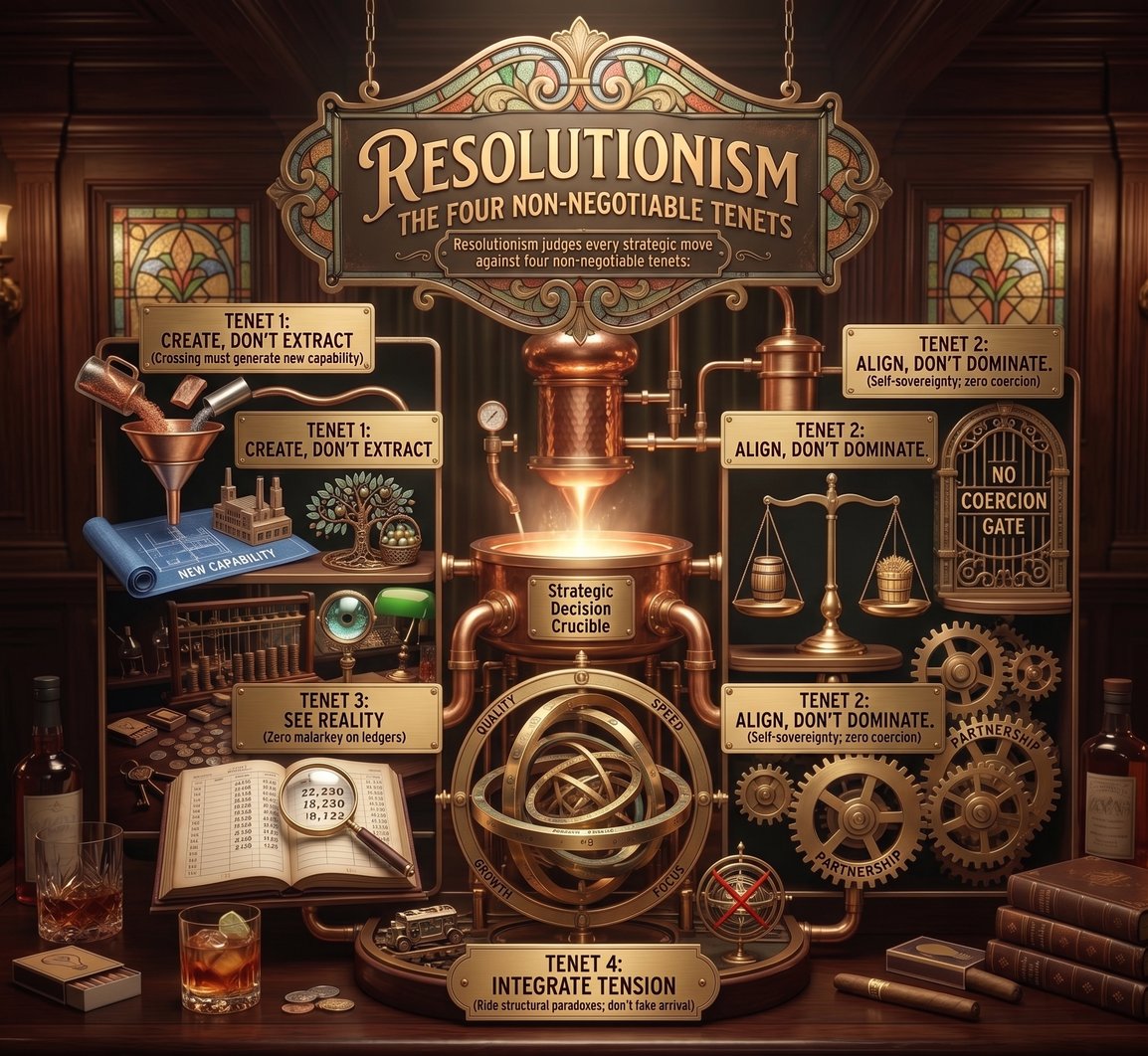
To keep an enterprise on the Beam, every strategy and operational build forged inside our grist hopper must satisfy the four group axioms of a self-balancing ledger:
- Axiom 1: Closure (No Off-Book Transactions): Every operational cost—workforce health, vendor fairness, factory scrap rates, and co-packer commitments—must sit directly on the visible ledger. Pushing equity extraction or agency overhead off-book to fake short-term venture valuations breaches Closure.
- Axiom 2: Associativity (One Story Across All Vantages): The commercial ledger reads identically whether viewed by an investor, an auditor, a bench formulator, a retail buyer, or an end consumer. If a spin-out story requires modifiers or fine print to balance from a specific angle, the enterprise is broken.
- Axiom 3: Identity (The Sovereign Center & Q5 Alternative-To): Before setting directional motion or spinning out a new entity, an enterprise must answer Question 5 (The Alternative-To): What does the shopper reach for on the shelf if your product vanishes tomorrow? Naming the default posture or unmet habit gives the business a load-bearing identity.
- Axiom 4: Inverse (Every Extraction Met by Restoration): Every operational draw against the value network must be dischargeable and actively discharged. Unsustainable equity dilution, supplier squeeze, or workforce exhaustion violates Inverse and triggers systemic decay.
When all four axioms hold, the enterprise generates Native Profit—the clean, mathematically verified surplus left over when every debt across the value network is fully discharged.
Step Past the Velvet Curtain: The MYNS2 Heliosphere
We do not run an assembly line where venture studios hand off to design, design hands off to formulation, and launch teams run around asking who's on first. MYNS2 operates as a Heliosphere: a bounded practice where integrated capabilities orbit a central strategic vortex, managed by one Impresario keeping the vision coherent alongside a curated bench of senior operators.
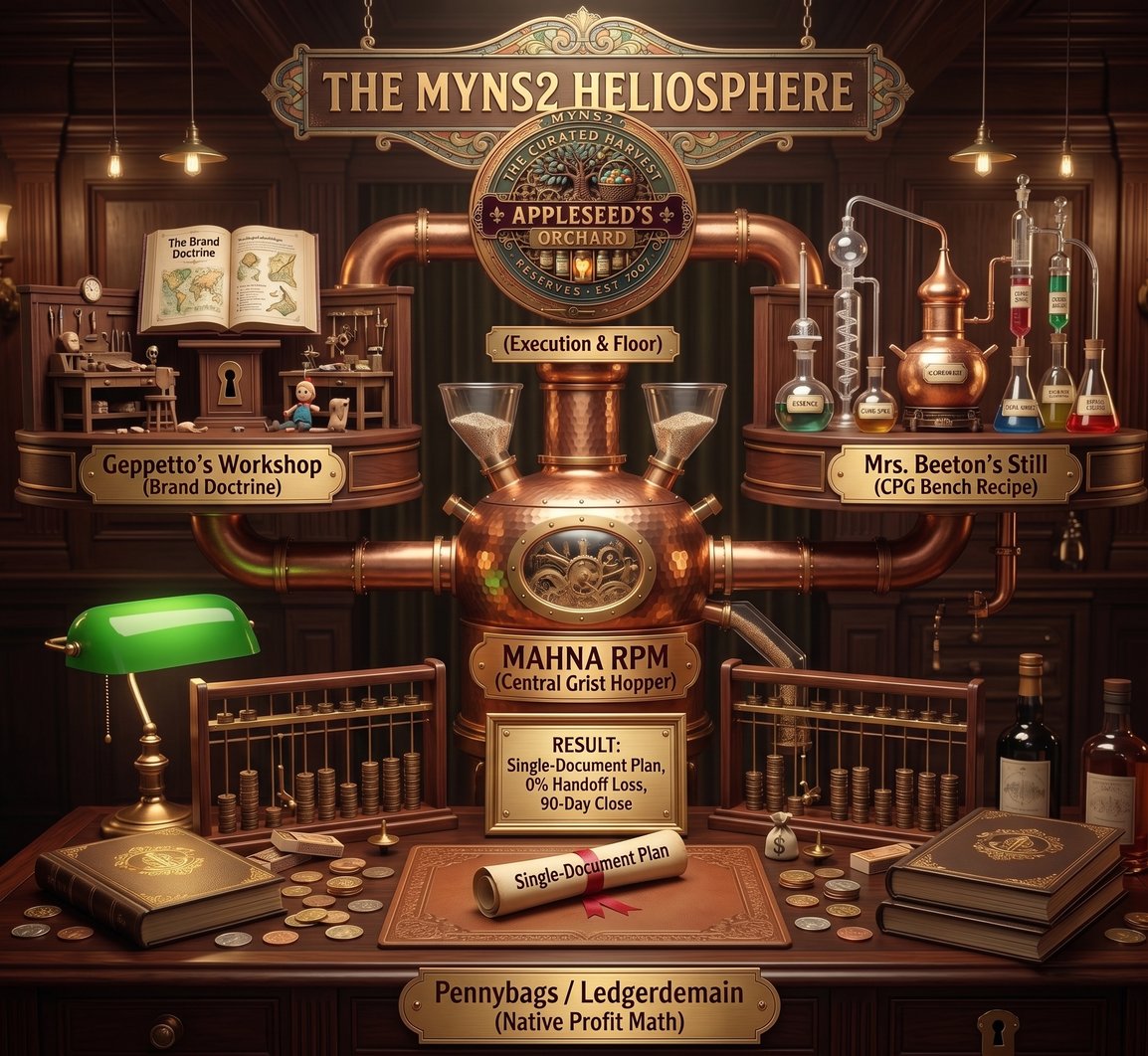
Every room in our sphere is built to eliminate handoff loss and drive native profit:
- Mahna RPM Strategy Engine: Diagnose structural rifts and chart your GTM flight plan.
- Geppetto's Workshop: Carve your brand's soul into an object that walks off retail shelves on its own two feet.
- Mrs. Beeton's Still-Room: Formulate unshakeable CPG recipes with green-eyeshade bookkeeper precision.
- Pennybags' Abacus & Ledgerdemain: Tune P&L marginalia to unlock Native Profit and test your numbers self-serve.
- Appleseed's Orchard: Deploy embedded fractional C-suite leadership (CMO, COO, CFO, Chief Innovation Officer) to run your floor.
Stop letting mob co-founders take a 40 percent cut of your equity for slide decks and unscalable MVPs. Belly up to the bar at MYNS2 —we will give you an unvarnished read on your business, tell you if you shouldn't hire us, and hand you an operational plan that steps into the market on its own two feet while keeping 100 percent of your Cap Table intact.
BLexi-Clog
A glossary of proprietary terms and speakeasy lexicon used throughout this post:
|
Word / Term |
Definition from MYNS2 Lexicon |
|
Appleseed's Orchard |
The execution arm of MYNS2 where embedded fractional C-suite operators take a seat on a client's land, run the floor for a defined tour, and hand over a functioning operation. |
|
Geppetto's Workshop |
The CPG brand invention room at MYNS2 where inert product ideas get carved, named, given a voice, and transformed into walking brand doctrines. |
|
Heliosphere |
The bounded working practice of MYNS2 where all capabilities (strategy, brand, formulation, execution, margin) orbit a central strategic engine without silos or handoff loss. |
|
Ledgerdemain |
Sleight of hand math for your P&L; MYNS2's software app that finds and tunes compounding marginal utility levers in a client's financial ledger. |
|
Looting Cascade |
An extractive corporate scheme where short-term numbers are inflated by taking value from workers, vendors, consumers, or supply chains out of sight on the ledger. |
|
Mahna RPM |
The overarching proprietary strategic hopper and methodology used by MYNS2 to turn raw market ideas into sequenced operational plans. |
|
Mob Co-Founder |
Slang for hybrid venture builders and studios that demand large equity stakes (20%-50%+) in exchange for temporary operational involvement. |
|
Mrs. Beeton's Still-Room |
The CPG formulation laboratory at MYNS2 where food science, sensory panels, and bench-card scale-ups are executed with bookkeeper precision. |
|
Native Profit |
Clean, sustainable financial surplus generated when an enterprise satisfies all four group axioms across its entire value network without extracting from workers, suppliers, or consumers. |
|
Panjandrums |
Self-important corporate authorities who pretend to hold absolute wisdom without operational accountability. |
|
Pennybags' Abacus |
The money-work practice at MYNS2 where senior team operators directly analyze P&L ledgers using Marginal Utility Theory to surface hidden profit levers. |
|
Resolutionism |
The core doctrine and philosophical approach of MYNS2 asserting that every enterprise is a living rhythm across a value network, and structural paradoxes must be held and resolved rather than smoothed over. |
|
The Alternative-To |
Question 5 of the Resolutionism audit: the single-sentence definition of the exact default posture, habit, or product a consumer reaches for if your product vanishes tomorrow. |
|
The Haul |
The final resolved strategic asset delivered by MYNS2—a fully actionable, non-consensus category entry plan ready for immediate execution. |
|
The Syndicate |
MYNS2's collective practice of Safecrackers and strategists who run the Mahna RPM. |
|
The Vault |
A client's locked strategic exploration, market category, formula barrier, or competitive landscape. |
External Industry Review References
For factual verification and review of external industry failure examples referenced in this post:
- Covisint Automotive B2B Spin-Out Collapse: "The Rise and Fall of Covisint," Harvard Business Review, 2005; see also: "Covisint: How $500M in Auto Consortium Capital Failed to Deliver," The Wall Street Journal, 2004. (Documenting joint-venture corporate politics, complex equity split disputes, supplier resistance, and severe value write-downs).
- Corporate Venture Studio Equity Dynamics: "Venture Studios vs. Corporate Innovation: The Equity Trap," Alloy Partners & BCG X Market Analysis, 2025/2026; "Why Corporate Venture Spin-Outs Fail to Achieve Independence," MIT Sloan Management Review, 2024. (Documenting 20%–50%+ equity demands, conflicting parent-studio board governance, and execution drop-off post-MVP).
- DTC Health-Tech Spin-Out Execution Failures: "Direct-to-Consumer Digital Health Post-Mortem," Journal of Commercial Biotechnology, 2025; "CAC Inflation and the Collapse of Venture Studio DTC Brands," Bloomberg Tech, 2025. (Confirming regulatory compliance disconnects, ad network CAC inflation, and parent corporate legal intervention).