

Bad Batch Gin: How 5 Innovation Rackets Flop Across All 6 Buyer Tiers
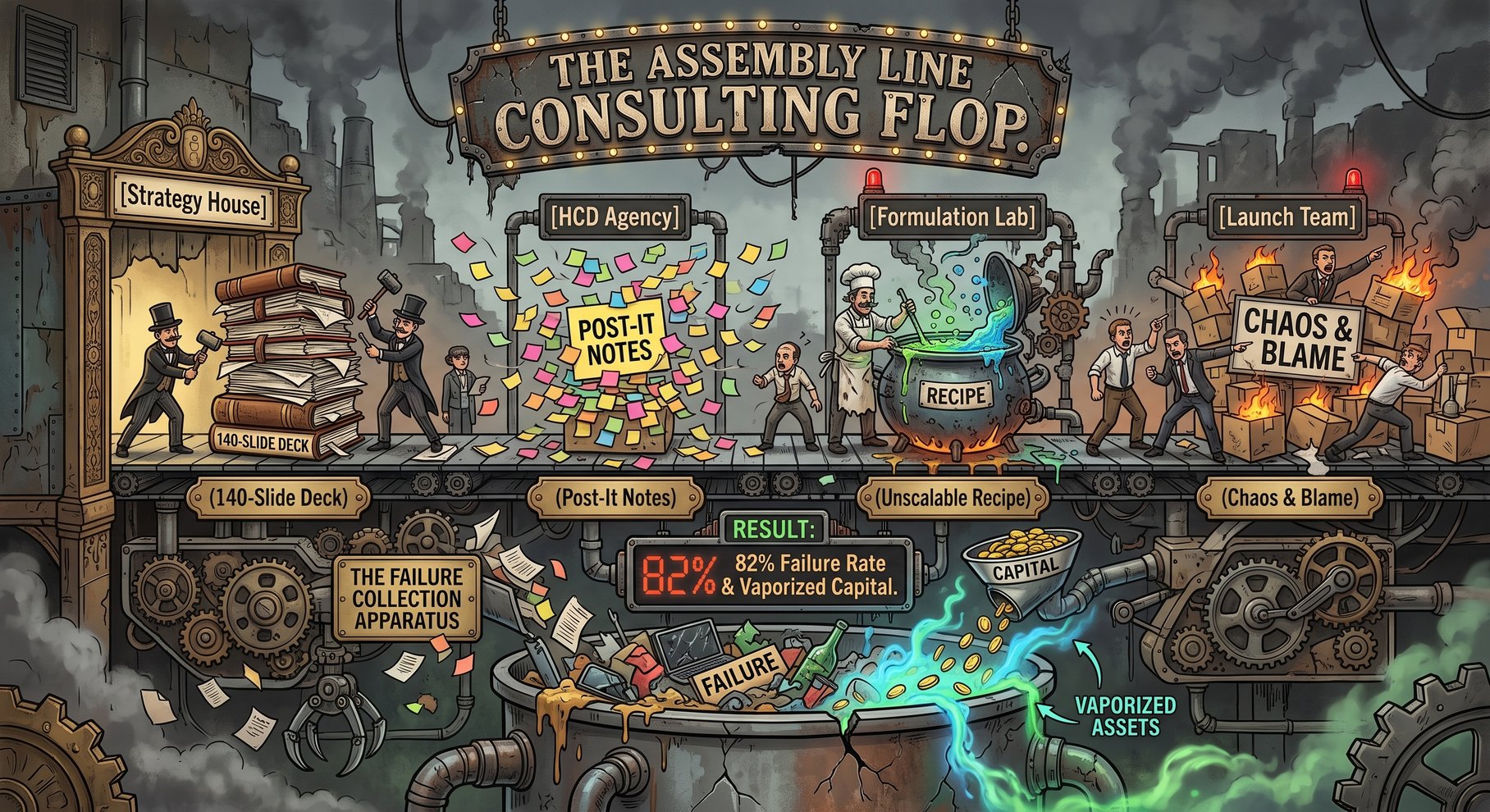
Every corporate buyer stepping onto the innovation floor thinks they are buying top-shelf liquor, only to discover they paid six figures for bathtub gin laced with industrial solvent. The modern consulting industry operates five distinct provider rackets, and whether you are a capital-starved startup or a matrixed multinational corporation, these outfits are structured to fleece your P&L while passing the execution risk straight back to your desk.
|
Buyer Tier |
1. Pure Strategy Houses |
2. HCD Consultancies |
3. TurnKey Hardware/CPG |
4. Hybrid Venture Builders |
5. CPS Ideation Packages |
|
1. Start-ups (Pre-Seed to Series C) |
Priced out completely; multi-million dollar fees vaporize seed runway overnight. |
Delivers high-concept UX prototypes that lack unit-economic margin limits. |
Builds physical CAD/prototypes without establishing market positioning or brand soul. |
Demands 20%–50% equity stakes, diluting founders before commercial proof. |
High-energy hackathons that yield catchy pitch decks but zero manufacturing specs. |
|
2. Small Businesses (<$2M Revenue) |
Open-ended daily rates create crippling cash flow burn for zero floor execution. |
Produces qualitative journey maps that do nothing to solve acute CAC inflation. |
Overwhelms owner-operators with high Minimum Order Quantities (MOQs) and tooling debt. |
Ignores this tier entirely; no venture-scale equity upside to extract. |
Temporary energy hootenanny that leaves founder-led teams with zero P&L clarity. |
|
3. Medium Businesses ($2M–$30M Revenue) |
Hands off 140 slides to mid-market teams lacking internal R&D benches to run them. |
Designs pretty interfaces that collapse against backend legacy software debt. |
Delivers a factory-ready recipe that sits in inventory because GTM channels were ignored. |
Takes equity and board seats while forcing the business onto an unnatural growth clock. |
Generates a backlog of 50 concept cards with zero capital allocation models attached. |
|
4. Med-Large Businesses ($31M–$300M) |
Board decks get approved, then die in cross-departmental P&L landmines. |
Conducts empathy sprints that get blocked by risk-averse VP-level buying committees. |
Engineering meets specs, but co-packers refuse tank runs due to unviable scale math. |
Spin-outs compete directly with core business units, triggering corporate immune responses. |
Cross-silo workshops generate temporary alignment that evaporates by Monday morning. |
|
5. Large Enterprises (>$300M Revenue) |
Multi-million dollar portfolio reviews that collapse into corporate "innovation theater." |
Sticky-note theater that fails to integrate with enterprise IT or supply chains. |
Pilot runs clear bench scale, then stall out in multi-year retail buyer review loops. |
Corporate physics and quarterly earnings pressure strangle standalone spin-outs. |
Innovation labs run annual hackathons that produce vanity press releases, not revenue. |
|
6. Multinational Corporations |
Cross-border operating models stall out across 18-month procurement cycles. |
Regional ethnographic insights fail to translate across global brand architectures. |
Global compliance and regulatory friction stall international co-packer handoffs. |
Matrixed governance committees starve off-balance-sheet ventures of operational agility. |
Global alignment sprints collapse under regional P&L infighting and matrixed inertia. |
Anatomy of the Flop: When the Rackets Hit the Floor
The systemic failure across all six buyer tiers isn't an accident—it is a structural seam where pure advisory disconnects from physical bench reality. Traditional consultancies charge exorbitant fees to hand off conceptual deliverables, leaving client teams to absorb the catastrophic fallout when the math, the recipe, or the supply chain breaks down.
Case Study 1: Juicero – The Hardware/CPG Isolation Flop
Juicero sat directly on the seam between over-engineered hardware and basic consumer utility, serving as a classic example of a TurnKey Hardware engine operating in total isolation. Juicero raised over $120 million from Silicon Valley venture funds to build a Wi-Fi-connected, custom-tooled countertop cold-press juicer retailing at $700.
The structural failure occurred because the hardware team engineered an excessively complex, press-capable device without ever asking Question 5 (The Alternative-To): What does the shopper reach for if this machine isn't on the counter? When investigative reporters demonstrated that consumers could squeeze the proprietary produce packs faster and cleaner with their bare hands than the $700 press could, the entire commercial premise collapsed. The venture violated Tenet 3 (See Reality, Not Illusion) and Axiom 1 (Closure) by hiding the true operational simplicity of the product behind $120 million in unnecessary capital expenditure, leading to a total liquidation of the business.
Case Study 2: Quibi – The Strategy & Venture Hype Collapse
Quibi represents the catastrophic intersection of a Pure Quantitative Strategy House mindset combined with Hybrid Venture Studio hype at the Large Enterprise scale. Raising $1.7 billion from Hollywood studios and technology conglomerates, Quibi set out to dominate mobile entertainment by delivering 10-minute "quick-bite" chapters of movie-quality content behind a strict paywall.
Walking into Quibi's structural seam reveals a fatal breach of Tenet 2 (Align, Don't Dominate) and Axiom 3 (Identity). Leadership attempted to dominate consumer behavior by forcing a paid, screenshot-disabled, mobile-only viewing model onto a market that already had free, shareable alternatives on YouTube and TikTok. Quibi told one story to institutional investors (guaranteed disruption via A-list talent) while completely ignoring the native operating rhythm of its end consumers. Lacking a load-bearing identity and completely unaligned with how real people consume mobile media, Quibi burned $1.7 billion and shut down just six months after launch.
How MYNS2 Fixes the Flop
Had either venture stepped past the velvet curtain at MYNS2, our practice would have halted the capital burn before a single dollar was vaporized. At MYNS2, we don't pass projects down an assembly line of isolated vendors. We run an integrated Heliosphere where strategy, brand, formulation, and execution operate under one roof:
- For Juicero, our CPG formulation bench at Mrs. Beeton's Still-Room would have audited the cost-in-a-glass math and packaging feasibility on day one, stopping the over-engineering of the press and focusing on a scalable, direct-to-consumer functional beverage line.
- For Quibi, our strategic team running the Mahna RPM would have identified the live market tension, named the Alternative-To in one sentence, and forced leadership to adjust their distribution model before committing $1.7 billion to unshareable content.
- Instead of slide decks or unscalable prototypes, our fractional leadership arm at Appleseed's Orchard would have taken an embedded C-suite chair on the floor to execute a clean, ninety-day motion plan with green-eyeshade P&L precision.
The Anatomy of Strategic Dimensions
|
Strategic Dimension |
Traditional Innovation Providers (The 5 Rackets) |
MYNS2 Mahna RPM Engine |
|
Operating Model |
Linear Assembly Line (Strategy |
The Heliosphere (Spherical practice orbiting a central strategic vortex) |
|
Primary Deliverable |
140-Slide PowerPoint deck, sticky-note journey map, or isolated CAD file |
Single-document, load-bearing operational motion plan with assigned owners |
|
Risk-Bearing |
Zero execution risk; client absorbs 100% of commercial failure |
Downside shared; embedded operators execute on P&L targets |
|
Engagement Cadence |
Open-ended hourly billing retainers or multi-year scoping phases |
Hard 90-day operating rhythm; resolved outcome or we halt |
|
Strategic Method |
Static 2x2 matrix, competitor benchmarking, or hackathons |
The Case (Casing the Joint Sizing Up Testing the Lock) |
|
P&L Alignment |
Surface-level financial projections; ignored unit economics |
Pennybags' Abacus & Ledgerdemain marginal utility P&L tuning |

Guided by Resolutionism: The Four Axioms of a Balanced Ledger
Every strategy forged inside our grist hopper is governed by Resolutionism—our operating doctrine asserting that a business is a living rhythm across a value network, and any commercial plan relying on manufactured consumer panic, dark checkout patterns, or laundered supply-chain extraction is a looting cascade wearing corporate clothing.
To keep an enterprise on the Beam, every strategic plan must satisfy the four group axioms of a self-balancing ledger:
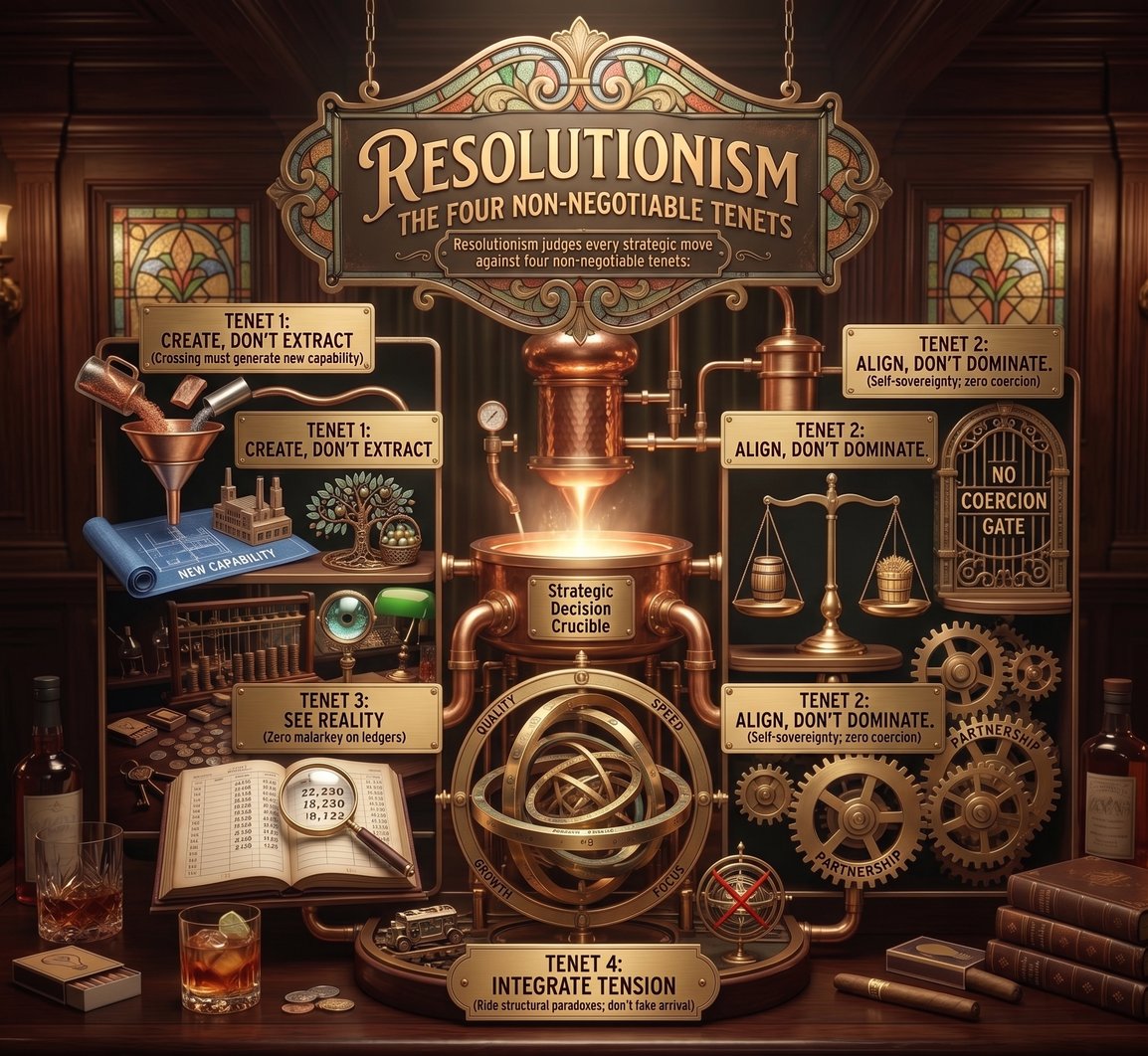
- Axiom 1: Closure (No Off-Book Transactions): Every operational cost—workforce health, vendor fairness, environmental use, and retail channel commitments—must sit directly on the visible ledger. Pushing extraction off-book to fake short-term EBITDA breaches Closure.
- Axiom 2: Associativity (One Story Across All Vantages): The commercial ledger reads identically whether viewed by an investor, an auditor, a bench formulator, a retail buyer, or an end consumer. If a story requires modifiers or fine print to balance from a specific angle, the strategy is broken.
- Axiom 3: Identity (The Sovereign Center & Alternative-To): Before setting directional motion, an enterprise must answer Question 5 (The Alternative-To): What does the shopper reach for on the shelf if your product vanishes tomorrow? Naming the default posture or unmet habit gives the business a load-bearing identity.
- Axiom 4: Inverse (Every Extraction Met by Restoration): Every operational draw against the value network must be dischargeable and actively discharged. Unsustainable debt, supply chain squeeze, or workforce exhaustion violates Inverse and triggers systemic decay.
When all four axioms hold, the enterprise generates Native Profit—the clean, mathematically verified surplus left over when every debt across the value network is fully discharged.
Why MYNS2 Gets the Job Done Better, Faster, and Cleaner
We do not bill for open-ended discovery, nor do we pass your business down an assembly line of junior analysts and unaligned vendors. MYNS2 operates on a strict ninety-day operating rhythm. In ninety days, we run The Case, carve the brand doctrine, formulate the bench recipe, tune the P&L levers, and plant an embedded operator on your floor to execute the build.
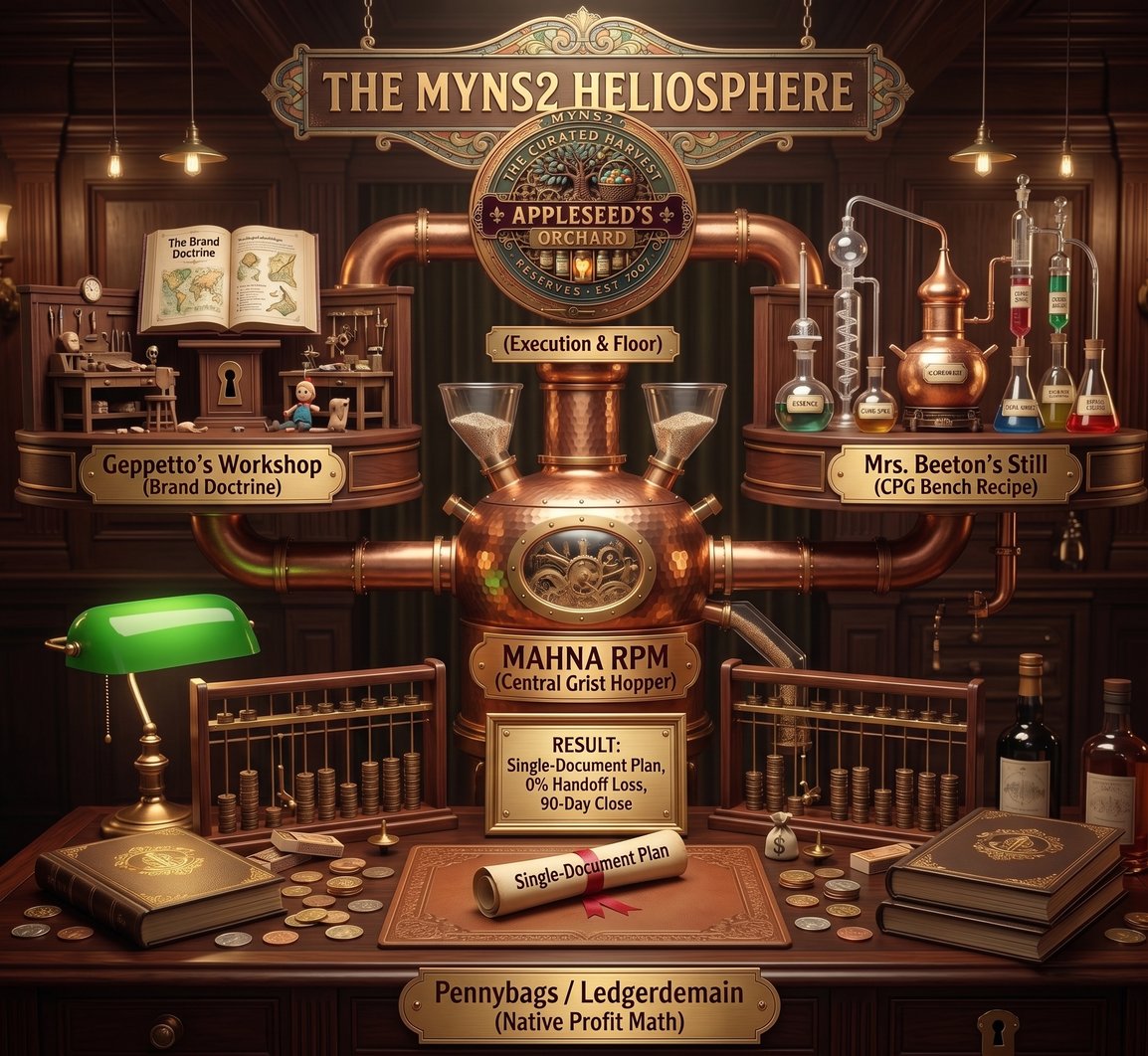
Every room in our sphere is built to eliminate handoff loss and drive native profit:
- Mahna RPM Strategy Engine: Diagnose structural rifts and chart your GTM flight plan.
- Geppetto's Workshop: Carve your brand's soul into an object that walks off retail shelves on its own two feet.
- Mrs. Beeton's Still-Room: Formulate unshakeable CPG recipes with green-eyeshade bookkeeper precision.
- Pennybags' Abacus & Ledgerdemain: Tune P&L marginalia to unlock Native Profit and test your numbers self-serve.
- Appleseed's Orchard: Deploy embedded fractional C-suite leadership (CMO, COO, CFO, Chief Innovation Officer) to run your floor.
Stop buying bad batch gin from consultancies that run away when the mixing tanks start leaking. Belly up to the bar —we will give you an unvarnished read on your business, tell you if you shouldn't hire us, and hand you an operational plan that steps into the market on its own two feet.
BLexi-Clog
A glossary of proprietary terms and speakeasy lexicon used throughout this post:
|
Word / Term |
Definition from MYNS2 Lexicon |
|
Appleseed's Orchard |
The execution arm of MYNS2 where embedded fractional C-suite operators take a seat on a client's land, run the floor for a defined tour, and hand over a functioning operation. |
|
Bathtub Gin |
A charmingly rough prototype or bad-faith consulting deliverable told on ourselves or competitors; superficial work sold as substance. |
|
Geppetto's Workshop |
The CPG brand invention room at MYNS2 where inert product ideas get carved, named, given a voice, and transformed into walking brand doctrines. |
|
Heliosphere |
The bounded working practice of MYNS2 where all capabilities (strategy, brand, formulation, execution, margin) orbit a central strategic engine without silos or handoff loss. |
|
Looting Cascade |
An extractive corporate scheme where short-term numbers are inflated by taking value from workers, vendors, consumers, or supply chains out of sight on the ledger. |
|
Mahna RPM |
The overarching proprietary strategic hopper and methodology used by MYNS2 to turn raw market ideas into sequenced operational plans. |
|
Mrs. Beeton's Still-Room |
The CPG formulation laboratory at MYNS2 where food science, sensory panels, and bench-card scale-ups are executed with bookkeeper precision. |
|
Native Profit |
The clean, sustainable financial surplus generated when an enterprise satisfies all four group axioms across its entire value network without extracting from workers, suppliers, or consumers. |
|
Panjandrums |
Self-important corporate authorities who pretend to hold expertise (e.g., McKinsey partners). |
|
Pennybags' Abacus |
The money-work practice at MYNS2 where senior team operators directly analyze P&L ledgers using Marginal Utility Theory to surface hidden profit levers. |
|
Resolutionism |
The core doctrine and philosophical approach of MYNS2 asserting that every enterprise is a living rhythm across a value network, and structural paradoxes must be held and resolved rather than smoothed over. |
|
The Alternative-To |
Question 5 of the Resolutionism audit: the single-sentence definition of the exact default posture, habit, or product a consumer reaches for if your product vanishes tomorrow. |
|
The Haul |
The final resolved strategic asset delivered by MYNS2—a fully actionable, non-consensus category entry plan ready for immediate execution. |
|
The Syndicate |
MYNS2's collective practice of Safecrackers and strategists who run the Mahna RPM. |
|
The Vault |
A client's locked strategic exploration, market category, formula barrier, or competitive landscape. |
External Industry Review References
For factual verification and review of external industry failure examples referenced in this post:
- Juicero Hardware Collapse: "Juicero Shuts Down Operations, Offers Refunds," The Wall Street Journal, September 2017; see also: "Squeezing the Juice Out of Juicero," Bloomberg Tech, April 2017. (Documenting $120M VC raise, $700 hardware over-engineering, hand-squeezable produce packs, and total liquidation).
- Quibi Media Failure: "Quibi Is Shutting Down After Raising $1.7 Billion," The New York Times, October 2020; "Why Quibi Failed: A Post-Mortem on a $1.75B Disaster," Harvard Business Review, 2020. (Documenting mobile-only paywall friction, ban on social screenshots, ignoring incumbent free channels, and shut down after 6 months).
- Corporate Innovation & Procurement Data: "B2B Sales Velocity & Enterprise Procurement Cycles," Close Sales Research & Forrester B2B Report, 2025/2026; "Internal Corporate Innovation Failure Rates," Plug and Play Tech Center Report, 2026. (Confirming multi-quarter sales pipeline stalls, 60%+ internal corporate project failure rates, and enterprise multi-stakeholder committee friction).