

Busting the Commercial Racket: How MYNS2 Eliminates Structural Friction and Recaptures Market Whitespace
If you step inside the traditional turnkey commercialization joint, you will quickly discover that the house always plays with loaded dice. Legacy innovation engines structure their businesses to maximize your billable hours, trap your intellectual property in restrictive licensing webs, or subsidize their front-end design fees just to force you into predatory contract manufacturing agreements.
The Commercial Blueprint of Legacy Innovation Engines
To navigate the market, enterprise leaders must see the underlying financial mechanics, engagement durations, and IP traps deployed across the competitive landscape.
|
Commercialization Firm |
Estimated Headcount & Scale |
Engagement Duration |
Intellectual Property (IP) Posture |
Pricing Architecture & Commercial Range |
Strategic Framework & Monetization Link |
|
Nottingham Spirk |
50–75 staff |
12 months |
Client-assigned or shared equity/royalty structures |
$50k–$120k+/month retainer; hybrid 1%–5% royalties or equity co-investments |
Vertical Innovation®: Monetized via pre-production tooling sign-off, factory sourcing, and equity stakes. |
|
Battelle Memorial Institute |
3,000+ scientists & engineers |
12–48 months |
Aggressive institutional patent creation and out-licensing |
Milestone FFP or Cost-Plus ($500k to $50M+) |
TRL Progression Pipeline: Monetized via pilot synthesis, contract research, and ongoing patent licensing fees. |
|
Veranex |
1,000+ MedTech specialists |
12–36+ months |
Client-assigned under fee-for-service |
Milestone fee-for-service ($250k to $10M+) |
Regulatory CDMO: Front-end design is positioned to secure downstream long-term clinical contract manufacturing spend. |
|
Radius (Jabil) |
150–250 (consulting) / 140k (parent) |
6–18 months |
Work-for-hire client assignment |
Fee-for-service retainers ($150k to $1.5M+) |
EMS DFX Integration: Front-end engineering fees are subsidized to secure high-volume production for parent factories. |
|
Synapse Product Development |
75–100 engineers |
6–15 months |
Complete client ownership |
Time & Materials ($225–$375/hr) or fixed milestone ($500k–$3.5M+) |
Agile NPI Hardware Sprints: Pure fee-for-service monetization; delivers production files and factory test fixtures. |
|
DEKA Research & Development |
500–750 engineers & machinists |
18–48 months |
Retains foundational IP architectures; negotiates exclusive licenses |
Multi-million dollar retainers ($2M to $20M+) plus downstream running royalties |
First-Principles Applied R&D: Monetized via massive R&D retainers tied to long-term category out-licensing royalties. |
|
Mattson & Co. |
50–80 food scientists & chefs |
6–12 months |
Complete client ownership of final formulation |
Phase-gated project retainers ($60k to $250k+ per SKU platform) |
Culinary-to-Industrial Scaling: Open-market formulation monetization; sells pilot formulation and plant scale-up. |
|
Imbibe, Inc. |
180–200 beverage specialists |
4–9 months |
Formulation transfer paired with captive flavor/ingredient trade secrets |
Low upfront fees ($25k–$100k+) offset by recurring ingredient supply contracts |
Custom Liquid Architecture: Monetized via ongoing sales of proprietary flavor pre-mixes directly to co-packers. |
|
Flavorchem (The Bench) |
200–400 corporate staff |
8–16 weeks |
Open beverage formulation with proprietary flavor compound supply |
Service fees for pilot canning ($15k–$60k+) |
Automated Pilot Canning: Short-run canning operates as a gateway to capture high-margin commercial flavor compound sales. |
|
Product Ventures |
45–60 packaging designers |
4–10 months |
Complete client assignment of design and utility patents |
Fixed-fee milestone contracts ($100k to $750k+) |
Consumer-Informed Actionable Process: Monetized via pre-production packaging CAD, blow-mold tooling, and factory ramp oversight. |
Systemic Weaknesses and Captured Whitespace
The structural breakdown of these legacy models reveals three major friction points that plague clients:
- The Captive Factory Trap: Consultancies tied to contract manufacturing parents (such as Radius with Jabil or Veranex with its CDMO lines) or proprietary ingredient suppliers (like Imbibe and Flavorchem) suffer from structural bias. Their front-end advice is rarely objective; it is engineered to funnel your product directly into their high-margin production lines or captive flavor pre-mixes.
- Predatory Retainer Overheads: High-headcount development houses carry massive fixed operational costs. To keep their pilot plants and machining suites utilized, they stretch six-week strategic explorations into 12-to-48-month retainer marathons, vaporizing client runway before a product ever hits a retail shelf.
- IP Encumbrance: Outfits like DEKA and Battelle retain core underlying patent architectures or demand running royalties, forcing enterprise partners into perpetual licensing fees for technology they funded to develop.
The emerging market whitespace belongs to an agile, unencumbered partner that provides 100% open-architecture solution agnosticism, surrenders all intellectual property, operates with zero captive factory bias, and executes strategy and bench chemistry within a strict, non-negotiable timeframe.
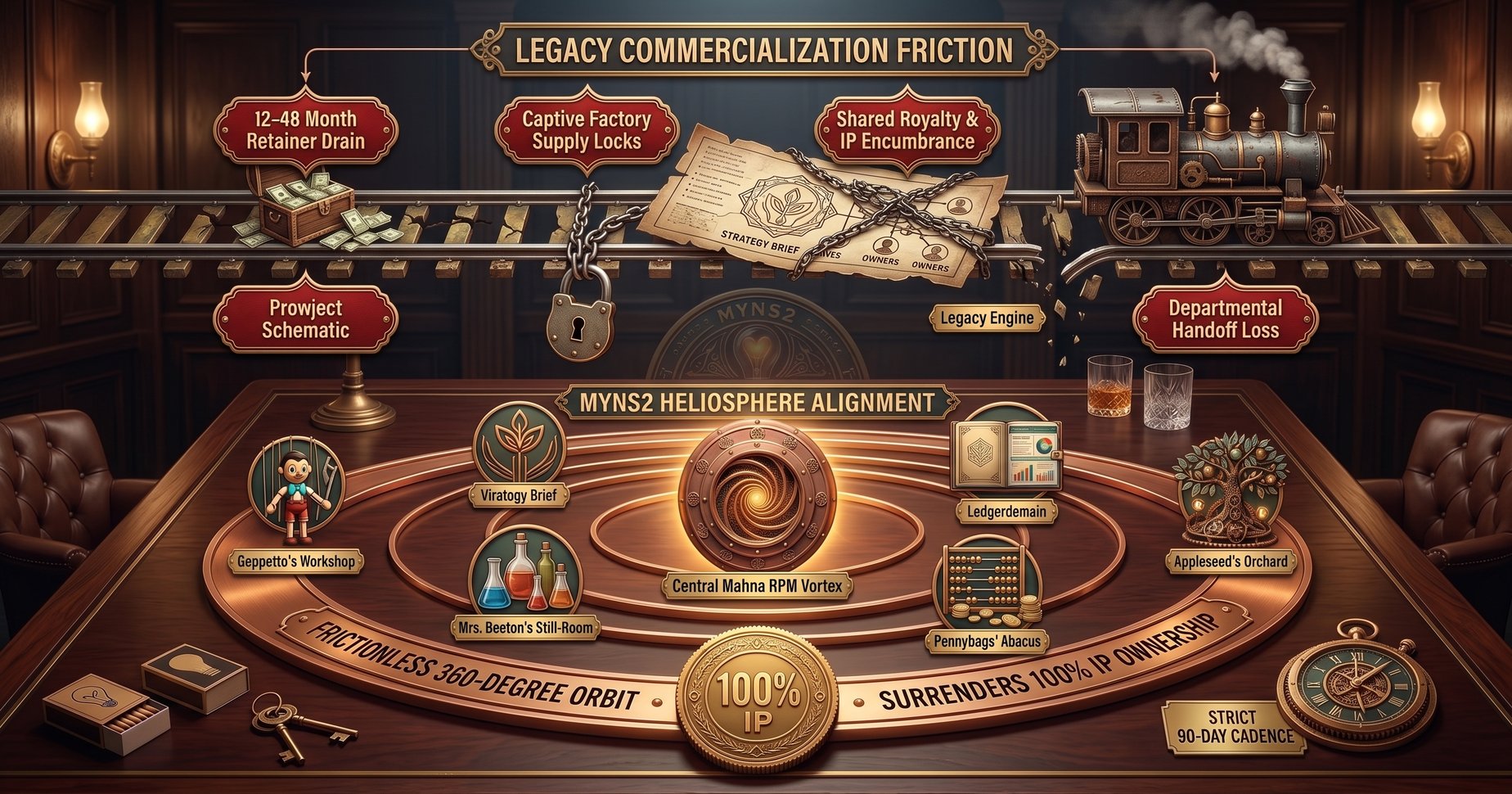
When the System Snaps: Recent Industry Disasters
When enterprise brands build on legacy frameworks that ignore real unit-economic constraints, the operational friction inevitably causes a catastrophic collapse. Consider two major industry trainwrecks from the past five years:
- BowFlex Inc. / Nautilus (March 2024 Chapter 11 Bankruptcy): Fitness giant BowFlex spent years operating under legacy hardware commercialization frameworks. They accumulated massive fixed IP licensing costs, over-leveraged their supply chain with injection-molded inventory during peak demand, and failed to re-align their hardware P&L margins when consumer habits shifted. Trapped in a high-overhead setup with suffocating debt and decaying margins, BowFlex went belly-up in March 2024, liquidating its assets to a competitor.
- Canoo / Lordstown Motors EV Hardware Scale-Up Failures (2023–2024): Electric vehicle hardware startups Canoo and Lordstown Motors burned through billions in capital utilizing traditional, high-headcount engineering consultancies. Rather than proving cost-in-a-glass unit margins and modular assembly feasibility on low-volume pilot cells first, they spent hundreds of millions building custom factory tooling and proprietary IP architectures. When supply chain bottlenecks hit, their uncalibrated unit economics collapsed, Lordstown filed for bankruptcy, and Canoo faced severe going-concern warnings after burning through its cash reserves.
How MYNS2 Cracks The Vault Better
Had BowFlex or Canoo walked past the velvet curtain into our speakeasy, a MYNS2 Safecracker would have immediately run The Case across our Blind Tiger Web.
Rather than letting engineering teams build hyper-custom hardware or unscalable supply chains in a vacuum, The Syndicate would have mapped the seven Safehouses governing the category. We would have located the exact Borromean Tumblers holding the operation in Antinomy Static.
Instead of blowing millions on captive factory builds or over-engineered prototypes, MYNS2 would have carved the brand doctrine in Geppetto's Workshop, tuned the P&L margins in Pennybags' Abacus or via Ledgerdemain, formulated any chemical or material substrates in Mrs. Beeton's Still-Room, and placed a battle-tested operator from Appleseed's Orchard directly in the Chief Operating Officer chair to run the floor.
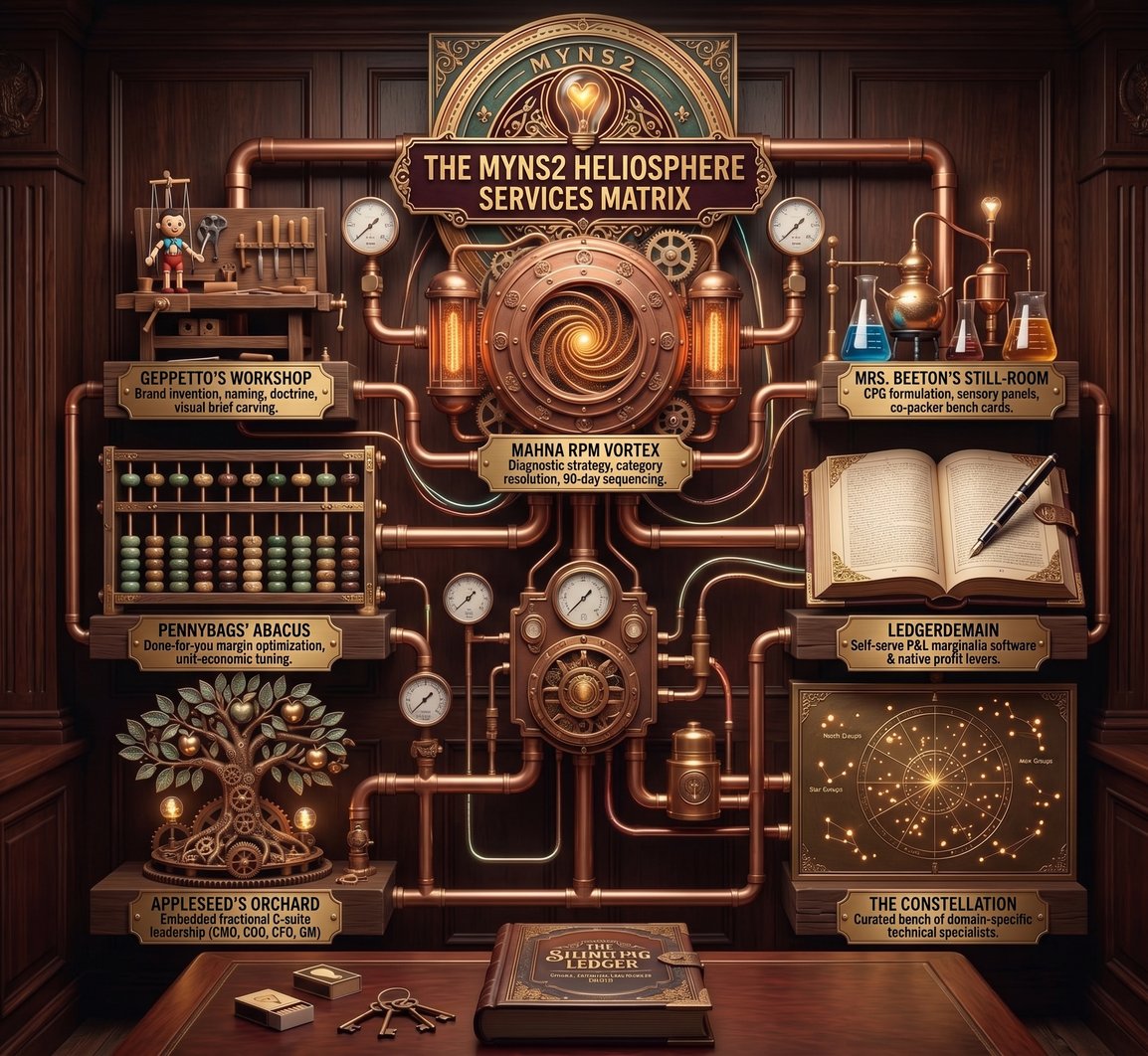
The Power of the Strategic Engine: The Benefits of Mahna RPM Outputs
Our central strategic engine, the Mahna RPM, is what makes MYNS2 structurally aligned to capture every whitespace left open by legacy consultancies. We don't discuss internal mechanics or mathematical equations; we focus purely on the load-bearing commercial outputs delivered to our clients.
How MYNS2’s Mahna RPM Outputs Obliterate Legacy Consultancies
|
Strategic & Commercial Dimension |
Legacy Turnkey Consultancies |
MYNS2 Mahna RPM Strategy Output |
|
Market Positioning |
Forces clients to compete on the crowded left (cheaper) or right (better). |
Uncovers The Middle Position Without The Guess—derived, defensible market space. |
|
Cross-Functional Alignment |
Linear handoffs across fragmented design, strategy, and formulation silos. |
One Direction. All Teams. Strategy, brand, formulation, and sales brief from one asset. |
|
Intellectual Property |
Demands shared equity, patent licensing fees, or running royalties. |
100% Client IP Ownership. Every CAD file, bench card, and playbook belongs to you. |
|
Manufacturing Freedom |
Captive factory locks or proprietary ingredient pre-mix supply contracts. |
100% Open-Market Agnosticism. Formulations designed for open-market sourcing. |
|
Commercial Speed |
Retainer-driven cycles dragging out from 12 to 48 months. |
Ninety-Day Resolved Outcome. Fixed-horizon workstreams that deliver shipped products. |
|
Financial Yield |
Focuses on top-line vanity metrics while eroding gross margins. |
Generates Native Profit—clean, sustainable surplus left when all debts are discharged. |
Guided by Resolutionism for Business
Underpinning our entire practice is Resolutionism for Business—the operating doctrine asserting that a business is a coherent rhythm across a value network, and that any commercial plan relying on underpaid labor, manufactured consumer panic, or laundered supply-chain extraction is a looting cascade wearing corporate clothing.

Here is how our tenets guide our structural alignment per topic:
- Tenet 1: Create, Don't Extract. We refuse to hold your intellectual property hostage or lock you into captive flavor pre-mixes. In Mrs. Beeton's Still-Room and Geppetto's Workshop, we build open-architecture recipes and brand doctrines that give your business genuine, permanent enterprise capability rather than long-term agency addiction.
- Tenet 2: Align, Don't Dominate. In Appleseed's Orchard, our embedded fractional C-suite operators align with your internal team's native operating cadence rather than forcing top-down corporate mandates or artificial retainer panic.
- Tenet 3: See Reality, Not Illusion. We run two ledgers on one page. In Pennybags' Abacus and Ledgerdemain, we audit your unit economics with bookkeeper precision. If a proposed product line cannot generate clean Native Profit on a commercial co-packer line, we deliver the "don't launch" verdict out loud and hand over the read for free.
- Tenet 4: Integrate Tension, Don't Deny It. Permanent commercial tensions—such as speed-to-market versus supply chain stability, or premium packaging aesthetics versus unit margin—are brought onto the bench, balanced without pretense, and built into a load-bearing motion plan.
Why MYNS2 Is Structurally Aligned to Win
When you partner with MYNS2, you bypass every structural failure mode that drags down traditional innovation engagements. You aren't hiring a bloated firm that needs to subsidize a massive factory footprint or keep a 3,000-person headcount busy with open-ended research contracts.
You are engaging an Impresario who orchestrates a curated bench of senior operators with over two decades of hands-on experience building, formulating, carving, and scaling real-world CPG and physical hardware platforms.
We eliminate the strategy-execution disconnect entirely. The same load-bearing logic forged in the Mahna RPM flows seamlessly into Geppetto's Workshop to carve your brand soul, into Mrs. Beeton's Still-Room to formulate your open-market bench cards, into Pennybags' Abacus or Ledgerdemain to tune your P&L levers, and into Appleseed's Orchard where embedded C-suite leaders run your factory floor.
We operate on a strict ninety-day cadence. When day ninety closes, all obligations are fully discharged, your internal team holds 100% of the IP keys, and your business stands on retail shelves compounding mathematically clean Native Profit quarter after quarter.
BLexi-Clog
- The Outfit: MYNS2; the overarching enterprise or operating practice.
- The Joint: The business, enterprise, or commercial operation being evaluated.
- The Racket: A specific line of business, category, or industry.
- Safecracker: A MYNS2 strategic practitioner who executes the Mahna RPM framework.
- The Syndicate: MYNS2’s collective practice of senior operators and strategists.
- The Vault: The client's market category, strategic exploration, or competitive landscape.
- The Case: The core recursion loop (Casing the Joint
 Sizing Up Testing the Lock) used to analyze a market.
 - The Crack: Releasing market tension to transform category stalemate into open strategic space.
- The Gin Mill Circuit: The exact, ordered sequence in which market tumblers must be released.
- The Getaway: The validated, settled route signaling that the market matrix has resolved.
- The Haul: The concrete, fully resolved strategic asset delivered to the client.
- Native Profit: Clean, sustainable financial surplus left over when every debt across the value network is fully discharged.
- The Alternative-To: The one-sentence default habit or product the shopper reaches for if your brand vanishes.
External Industry Failure References
- U.S. Bankruptcy Court for the District of Washington. In re BowFlex Inc. (f/k/a Nautilus, Inc.), et al., Case No. 24-10231 (March 2024).
- U.S. Bankruptcy Court for the District of Delaware. In re Lordstown Motors Corp., et al., Case No. 23-10831 (June 2023).
- Canoo Inc. Form 10-K Annual Reports & Going-Concern Analysis. U.S. Securities and Exchange Commission (2023–2024).